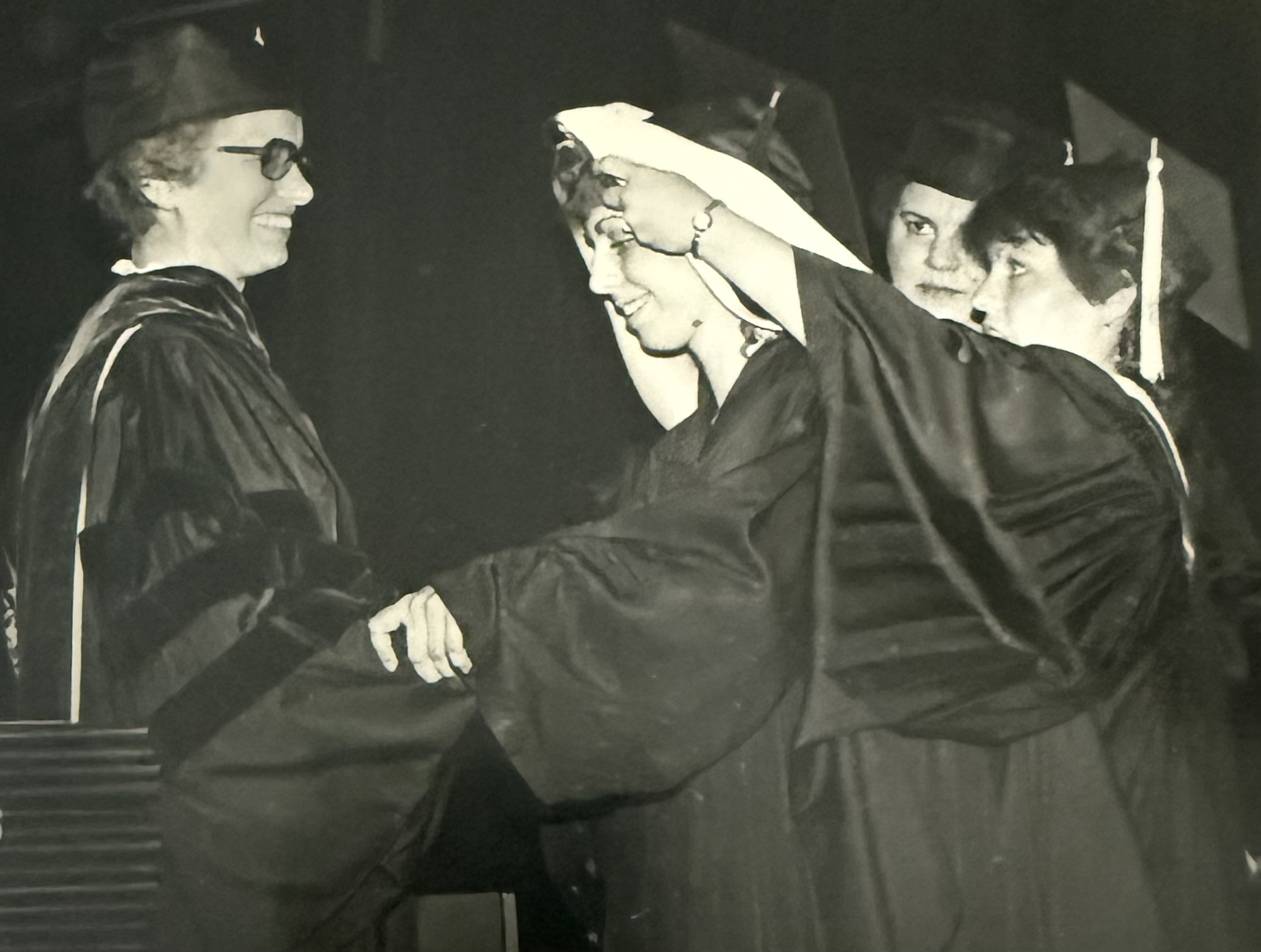

An academic hood is a curious thing unless you know what it means. Draped across the shoulders, it marks a degree earned, its colors showing the graduate’s school and field of study. At many colleges, hooding is reserved for master’s and doctoral candidates, though some schools, including Siena Heights, also hood baccalaureate graduates.
But this spring, at Siena Heights University’s final commencement, the gesture felt like something more. It felt like a blessing. It felt like farewell. It felt like history passing through our hands.
On Saturday, May 9, actor and comedian Bill Murray and his sister, Sister Nancy Murray, OP, an Adrian Dominican, received the final honorary doctor of humane letters degrees Siena Heights will ever confer. Minutes later, more than 400 graduates walked across the stage. I helped with hooding, and saw McNair scholars, students I had first known three years ago in freshman writing, and my granddaughter, all part of the final class Siena Heights will ever send into the world.
Murray, whose appearance had been kept a surprise, brought the expected humor. But beneath the jokes was something tender and true. Speaking to graduates of a university that will soon close its doors, he told them, “You don’t need a building to be who you already have become and who you will become.”
I knew he was right. And yet, buildings do hold memory.
Siena holds mine. It holds the memory of my own graduation, and five years later, the memory of my sister Catherine’s. Catherine was a Siena graduate, too, and her connection to the school began before she ever enrolled. According to my mother’s scrapbook, Catherine was named for St. Catherine of Siena. My mother’s own middle name was Kathryn, but for my sister she chose “Catherine” — the saint’s spelling — a link to the Dominican tradition of the school my mother herself had attended.
After major back surgery and a long recovery, Catherine returned to Siena and finished her degree. My mother never forgot that. In her scrapbook, she wrote of Catherine’s back surgery, “which became a disaster for her,” and how Catherine “bravely went back to Siena and graduated.”
When Catherine walked across the stage with her walker to receive her diploma in May 1985, I was there as an adjunct faculty member. I had the privilege of hooding my own sister. I do not think I fully understood then how much courage that walk required. I understand it better now.
Catherine died May 2. One week later, I stood at Siena’s final commencement, helping hood the last class ever to graduate from the school. The two losses are not the same. One is the loss of a beloved sister. The other is the loss of a beloved institution. But grief has a way of layering itself.
I thought back to December, when Catherine visited the Therapeutic Riding horse barn in Ann Arbor. By then, Friedreich’s ataxia had taken so much from her body, but it had not taken everything. Around those horses, she was not simply a patient or a resident in long-term care. She was Catherine — present, attentive, still reaching toward the world.
The same can be true of a place.
We will miss the buildings. We will miss Sacred Heart Hall and Siena’s own “Touchdown Jesus.” We will miss the familiar hallways, classrooms, chapel and fieldhouse — the places where we learned, taught, prayed, laughed and figured out who we were becoming.
But Siena is not finally its buildings. Siena is the students who walked those halls, the faculty who taught in those classrooms, the staff who kept the place running, the people who cooked meals in Benincasa, answered questions, opened doors, cleaned rooms, graded papers, listened to worries and showed up again the next day.
They are the heart of Siena. They are its life. They are its legacy.
That is what I saw at commencement: the last honorary degrees, fittingly given to Bill Murray and Sister Nancy Murray at a university founded by the Adrian Dominican Sisters in 1919; more than 400 graduates crossing the stage; my granddaughter among them; and students I once knew as first-year writers now standing taller, surer, more fully themselves.
Near the end of his remarks, Murray recalled what his mother used to say whenever one of her children faced a threshold: “Carry on and be brave.”
That may be what Siena’s final graduates now have to do. It may be what all of us who loved the place have to do. It is also what Catherine did, again and again, across every threshold illness placed before her.
Catherine is gone. Siena Heights will close. But what was formed in that place, and what was witnessed in her life, does not simply disappear.
It is carried forward — by graduates, by teachers, by families, by sisters — by all of us who are still learning how to carry on and be brave.
 SQUIBS