
As my 68th birthday approaches, I have been thinking a lot about my father.
Dad died Dec. 4, 1990, just eight days before his 70th birthday. For most of my life, 70 seemed old—or at least safely distant. Now I am approaching the age he was when he died, and the distance between us feels suddenly, uncomfortably small.
I inherited the heart disease that killed my father, his father and his grandfather, along with numerous relatives on my paternal grandmother’s side. Having reviewed a good number of death certificates in my family-history research, I can say that most of my ancestors died from some combination of heart disease, high blood pressure, diabetes, kidney failure and the like.
With the notable exception of my great-great-grandfather, who was struck by a train in 1902, it has mostly been about the ticker.
Perhaps that is why my approaching birthday has made me want to know more about my father—not simply as the man who raised me, but as the boy and young man he was before I knew him.
He was born Dec. 12, 1920, in Detroit, the first child of Verna Clara Brisbois and Eli Richard Lapham. My grandparents had married nearly two years earlier, on Jan. 28, 1919, at St. Francis Xavier Catholic Church in Ecorse.
They began married life with my grandfather’s family at 164 Woodmere in southwest Detroit. It must have been a crowded household. In addition to my grandparents, the family included my grandfather’s siblings and his two grandmothers, Julia Lapham and Eliza Gillman.
By the time Dad was born, my grandparents were living nearby at 793 Distel Street. His two younger brothers were also born in Detroit, possibly at home, and all three boys were baptized at All Saints Catholic Church.
My grandfather was working as an automobile mechanic, although I have not yet discovered where. He eventually worked for Ford at the Rawsonville plant, but before that, the family exchanged the streets and factories of Detroit for a farm off Pink Street in Norvell Township.
Dad once told me he was 5 when they moved to the Irish Hills. He may also have said it was 1925. Since he turned 5 in December of that year, either late 1925 or early 1926 would fit his memory.
In January 1928, my grandparents welcomed their fourth child and first daughter. They named her Juanita May.
At some point after 1930, during the Great Depression, my grandmother’s sister May Bondy also left Detroit for the farm with her husband, Henry, and their sons Richard and William, known as Billy.
The 1930 census shows the Bondys owning a Detroit home valued at $5,000. Henry was working as a pipe coverer at an asbestos plant. Whatever circumstances brought them to the farm—lost work, lost security or simply the need for family—the two households joined together there during some of the hardest years Americans had known.
Then, on Sept. 2, 1932, the unimaginable happened.
Juanita and Billy were killed in a haystack fire on the farm. They burned to death in front of their parents, their brothers, their aunt and uncle—and my father.
Dad was 11 years old.
I was named for Juanita and have written extensively about the fire. Yet I knew very little about it while my father was alive. I did not understand until I began researching our family history, long after his death, what he had witnessed as a child or what he must have carried with him afterward.
That knowledge changed the way I saw him.
The father I knew was not a man defined by sorrow. He loved Detroit sports, especially the Tigers. He loved his children and was enormously proud of them. He loved learning things.
When he bought our World Book encyclopedia set in 1974, I suspect he eventually read nearly every volume. In another generation, with other opportunities, he might have made a fine engineer. He could fix almost anything.
After the Palm Sunday tornadoes of 1965, he spent the following summer digging a basement beneath our house at 604 Cairns Street. He undertook the kind of project most people would never imagine attempting themselves. To Dad, it was apparently another problem to be studied and solved.
He had no desire to continue the farming life. Instead, he spent 42 years working at Tecumseh Products before retiring at age 62.
His hair turned silver prematurely, as it had for so many of his ancestors, and perhaps that is why he always seemed older to me. He was 37 when I was born, but 57 by the time my youngest brother arrived.
As a child, I saw the silver hair and thought of him as old. Now I understand how young he still was through so much of the life I remember.
Children tend to believe their parents’ lives began when they entered them. We know them as mothers and fathers, workers, disciplinarians, storytellers and fixtures in the family landscape. We rarely understand the children they once were or the losses that helped shape the adults they became.
My father did not talk much about the fire. Perhaps there were no words adequate to describe it. Perhaps people of his generation believed some things were best left buried. Or perhaps he had simply learned to live around the memory.
Twelve years later, in August 1944, that Detroit-born farm boy was 23 years old and serving in the Army at Camp Wolters, Texas, near Mineral Wells.
I had been trying to orient Camp Wolters in relation to Fort Hood, a part of Texas I had visited myself. Camp Wolters lay northwest of Fort Hood, closer to Fort Worth, in a region where August temperatures routinely climbed into the 90s and sometimes reached 100 degrees.
Dad was hospitalized there for what his military record called the “exhaustive effects of excessive heat”—heat exhaustion, in the language we would use today.
That small entry in his service record stops me.
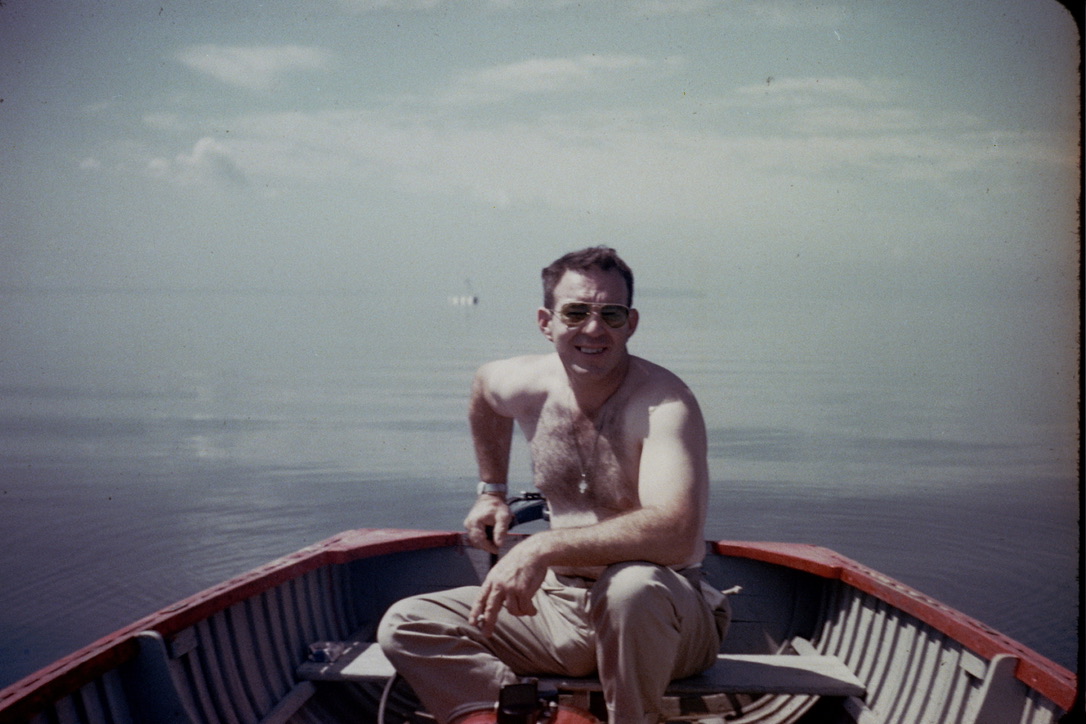
I can picture the father I knew watching the Tigers, reading the encyclopedia, fixing things and taking pride in his children. It is harder to picture him at 23, far from Michigan, dressed in an Army uniform beneath the Texas sun, sick enough from the heat to be hospitalized.
It is harder still to picture him at 11, standing on the farm while his little sister and cousin died before his eyes.
Yet both boys—the child at the haystack and the soldier at Camp Wolters—lived inside the father I knew.
Genealogy begins with names and dates, but if we stay with it long enough, the records sometimes give us something more. An address becomes a crowded family home. A census entry becomes a family displaced by the Depression. A death certificate becomes a little girl whose name was given to a niece she would never meet. A military notation becomes a young soldier overcome by the Texas heat.
And a birthday becomes a reckoning.
My father died eight days before he turned 70. I am about to turn 68.
I cannot know how much time separates me from the age he was when he died. None of us can. What I do know is that the years no longer feel abstract. They have made me more attentive to my health, more grateful for the life I have been given and more determined to understand the lives that came before mine.
For years, I thought of my father as belonging to an older generation and another time.
Now, as I approach the age he was when he left us, I feel myself closing the distance—not only between his lifespan and mine, but between the father I remember and the boy whose sorrows I learned only after he was gone.
 SQUIBS