
“The best grapes come from the hardest ground,” said Julian Ostermann, our guide at Domäne Wachau, one of Austria’s oldest wineries. He was talking about the terraced vineyards of the Wachau Valley, but the phrase lingered long after the tasting ended. It seemed true not only of the vines rooted in stony soil, but of the people who have tended them for centuries — and maybe, in a broader sense, of all of us.
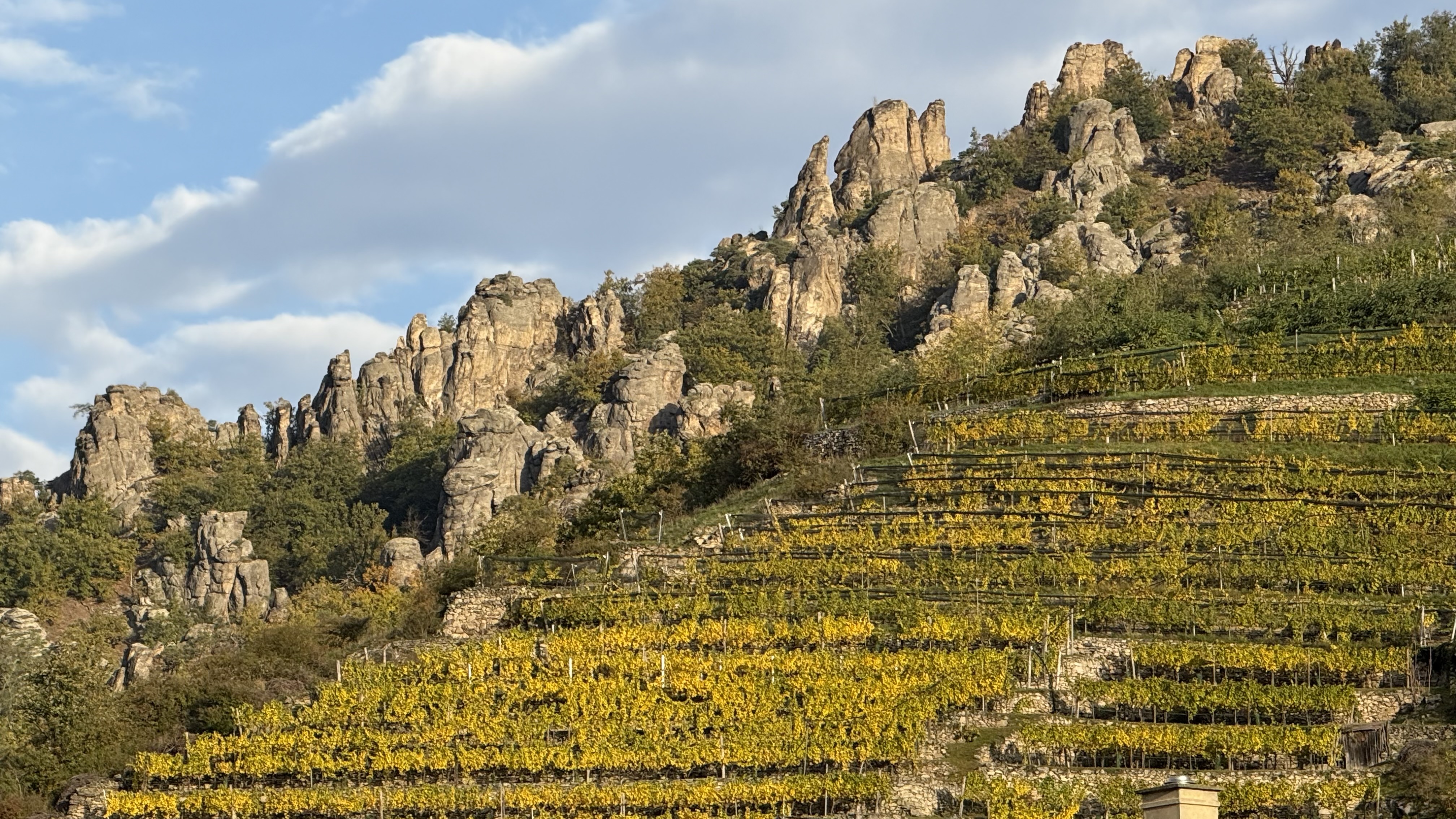
The winery was one of the stops on our Danube River cruise in October. It is nestled in the Wachau Valley (pronounced Vah-how), which stretches for about 25 miles between Dürnstein and Melk. Our cruise director, Amila Sehovic, called it the most beautiful stretch of the river, and she was right. In October, the vineyards turned to gold and amber, climbing the steep hills in orderly rows. Fall colors burst from the trees that framed the villages dotting the landscape above the water. The Danube shimmered as it wound its way between old castles and quiet towns.
Before our ship began this leg of the journey, we visited Domäne Wachau, a cooperative of hundreds of small growers who together cultivate thousands of acres of vines. The winery sits at the foot of Dürnstein’s vine-covered slopes, beneath the ruins of a castle where Richard the Lionheart is said to have once been imprisoned. The air smelled faintly of fermenting grapes and damp earth.
We arrived at the vineyard in the early morning, the sun reflecting off the dew on the vines. It was chilly and smelled of autumn. Julian began our tour describing how the winery functioned and the kinds of grapes grown there. Most of the grapes are Grüner Veltliner (pronounced GROO-ner VELT-lee-ner), Austria’s signature white wine grape and the one most closely associated with the country’s vineyards, especially along the Danube in the Wachau Valley.
“About 70 percent of what we grow is Grüner Veltliner, while 20 percent is Riesling,” he said. “We also have a little bit of Chardonnay and Muskateller. This is a white wine region — the cool climate and soil make it perfect.”
Julian explained that the Wachau has two distinct soil systems: loess, a sandy soil that holds moisture well and favors Grüner Veltliner, and gneiss, a rocky soil that is ideal for Riesling. The terraced vineyards of the winery rose in graceful lines above the Danube, creeping all the way up the steep hills that form the valley. Everything has to be done by hand, Julian told us, even the harvest.
“Workers climb those steep slopes carrying baskets that weigh up to 110 pounds,” he explained. “The higher the vines, the stronger their character. The best grapes come from the hardest ground.”
As we made our way toward the wine cellars where cool stone corridors opened into vaulted cellars lined with oak barrels, Julian introduced us to the wine-making process.
Domäne Wachau also is a leader in organic winemaking. For nearly 20 years, Julian said, the cooperative has worked to restore biodiversity — planting herbs and wildflowers between rows, using compost made from grape skins and stems, and nurturing the soil naturally.
“Healthy soil means healthy vines and better wine,” Julian said as he led the way through the cave-like chambers with their giant barrels and scent of fermenting grapes.
We climbed a steep staircase and made our way to a warm, inviting tasting room. Rolls, water, and wine glasses lined the tables.
We tasted four wines and a brandy that morning, each one a reflection of the land: three different Grüner Veltliner varieties, a Riesling, and the XA22 Veltlinerbrand — all shaped by the Wachau’s sunlight and stone. It was a meeting of soil, craft, and patience.
A short time later, we were back on the ship and making our way through the valley. Julian’s words stayed with me: “The best grapes come from the hardest ground.” I thought of how the same might be said of the people we’d already met who live and work along the Danube — and of the places that influence all of us. The Wachau’s beauty isn’t only in its golden vineyards or its famous wines, but in the quiet strength that thrives in this land and the people who shape it.
 SQUIBS