
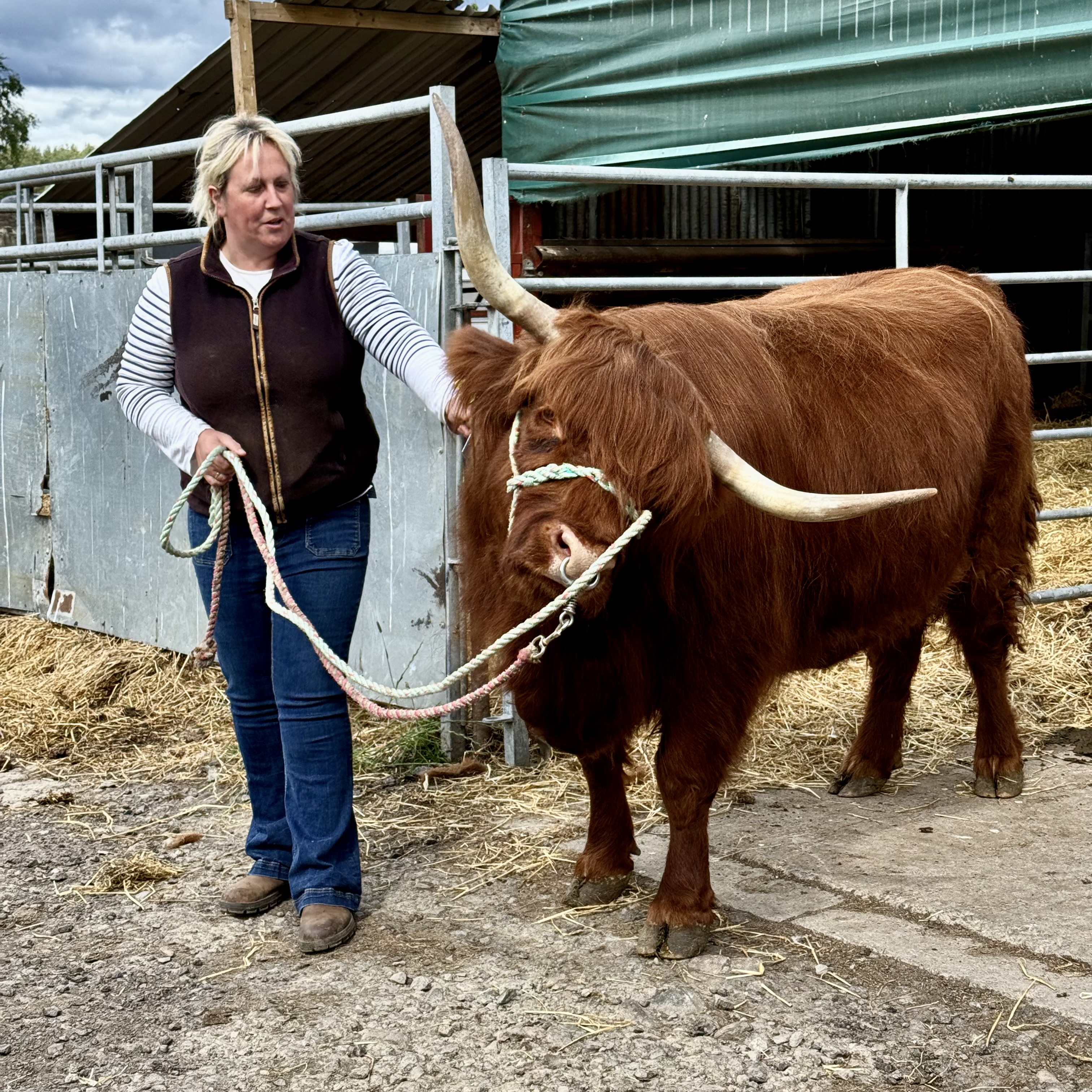
Nestled among the rolling hills near Banchory in Aberdeenshire, is a Highland cattle farm where the stars of the Scottish countryside graze—long-horned, shaggy-haired, and unmistakably charming. Inside the barn is Duchess, a Highland cow with a touch of celebrity. She’s graced calendars, appeared on cooking shows, and even turned up in documentaries, her photogenic fringe and steady gaze making her a natural in front of the camera.
We were welcomed by Grace Noble, who has been raising Highlands since 2012. She shared stories of life with the herd—the unpredictable weather, the joy of watching wobbly-legged calves find their footing, and the occasional challenge of managing cows whose horns could double as medieval weapons.
“Once they’re out in the pasture, they get along just fine,” Grace said. “But in close quarters… well, there can be a bit of a problem.”
Like any celebrity, Duchess takes her grooming seriously.
“She loves getting ready for visits and photo shoots,” Grace told us.
First comes the power wash—she adores the jets of water—followed by a shampoo with dishwashing liquid or Head & Shoulders. Then comes the blow-dry, a little mousse, and hairspray to set her fringe just so. Her horns get sanded smooth and polished with Johnson & Johnson baby oil until they shine.
“She likes that,” Grace said with a grin. “She loves the pampering.”
We all took part in the spa day with opportunities to brush Duchess’s thick coat. Highland cattle have two coats—a coarse outer layer and a softer undercoat that keeps them warm in Highland gales. After her beauty routine, even the outer layer was soft and glossy. Duchess clearly approved, leaning into the brush Grace wielded with an expression that could only be described as blissful, her head cocked almost sideways.
Of course, life on the farm isn’t all shampoos and photo ops. Highland cows can live 25 to 30 years, having a calf nearly every year. The bulls have shorter but busier careers, tending to about 50 cows annually, Grace explained. While Duchess and a few others have names and celebrity status, most of the herd supports the farm’s beef business.
“The cows that stay for breeding are all named,” Grace said. “The ones destined for the table are not.”
Grace grew up on the Isle of Skye, not far from one of our early stops in the Oban region. She studied environmental science at Strathclyde University in Glasgow and worked in that field for more than a decade before deciding to return to farming. In 2016, she secured a tenancy at Lochton of Leys, part of the Leys Estate, owned by the Burnett family since 1323. It’s the kind of place where the past doesn’t feel so far away.
Watching Duchess walk out to the pasture, it was easy to see how perfectly she belongs here. Her long bangs—the dossan—shield her eyes from wind and rain. She lives mostly on grass and water from nearby streams, with straw and the occasional potato treat to keep her looking her best.
Our visit to the farm was part of a June 16–27 tour of Scotland with alumni and friends of Siena Heights University, a journey that took us from the bustling streets of Glasgow and Edinburgh to Aberdeenshire’s quiet hillsides. Of all the castles, cathedrals, and coastlines we explored, few encounters were as memorable as meeting Duchess—hardy, a little glamorous in her own bovine way, and a little bit mischievous.
It’s not every day you meet a cow who gets her horns polished with baby oil, her hair fluffed with mousse, and still manages to look you straight in the eye as if to say, I was here long before you, and I’ll be here long after.
I’m sure she will.

 SQUIBS