
I was always good at geography. I could fill in a blank map of Europe in sixth grade and spell “Czechoslovakia” without looking it up. Those elementary years were a time of global turmoil—reflected in the maps I memorized, divided into Western Europe and Eastern Europe.
Western Europe was considered the “good” side: the United Kingdom, France, Italy, Spain, and the Scandinavian countries—Norway, where my ancestors were from—along with Sweden and Denmark. Finland was there too, though I don’t remember hearing much about it. Then there was the “bad” side—Eastern Europe—dominated by a single ominous shade of gray labeled “U.S.S.R.” and filled with countries “behind the Iron Curtain,” which, in itself, sounded scary.
So when I traveled last month through Hungary, Slovakia, Austria, Germany, and the Czech Republic, I couldn’t help but think how extraordinary it was to be there as a tourist—wandering freely through countries that, until 1991, had been closed off by ideology and fear.
We spent two days in Budapest, a city of grand architecture and great resilience. The Chain Bridge gleamed in the sunlight. You couldn’t tell that every one of its spans had been blown apart during World War II and later rebuilt–stone by stone. On the flatter Pest side is the 2005 Shoes on the Danube Bank memorial– 60 pairs of cast-iron shoes honoring some 20,000 Jews executed along the river in 1944. Victims were ordered to remove their shoes–a valuable commodity in wartime–before being shot at the water’s edge, their bodies toppling into the river and carried away by the current. Many were women, children, and the elderly.
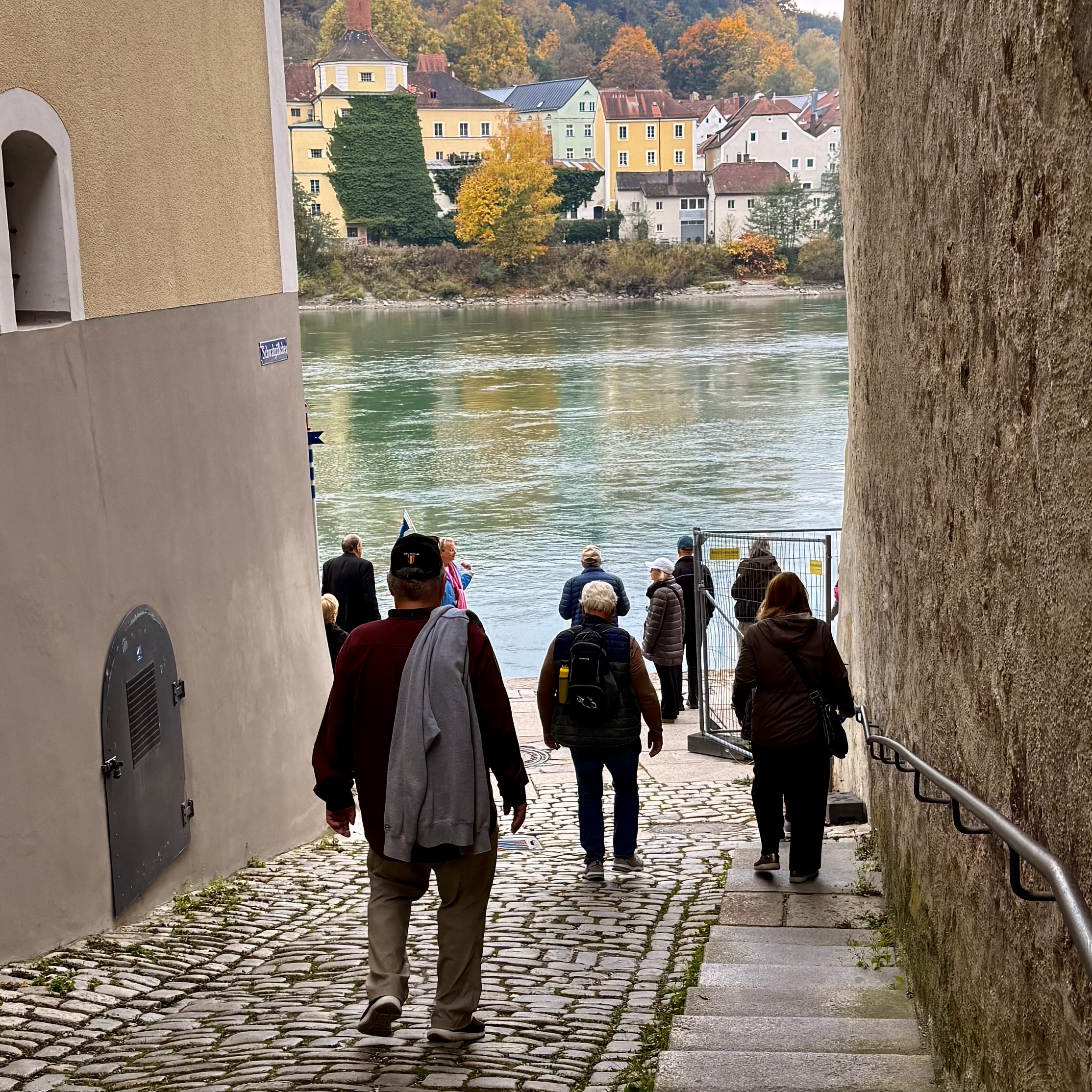
The Danube was once a dividing line—the West on one bank, the East on the other. Today, cyclists ride along its paths, riverboats pass without inspection, and border stations stand empty. Freedom has a quiet appearance: people sipping coffee and wine at outdoor cafés, young riders weaving through crowds on Segways and e-bikes, and locals free to criticize the government without fear of being “disappeared.”
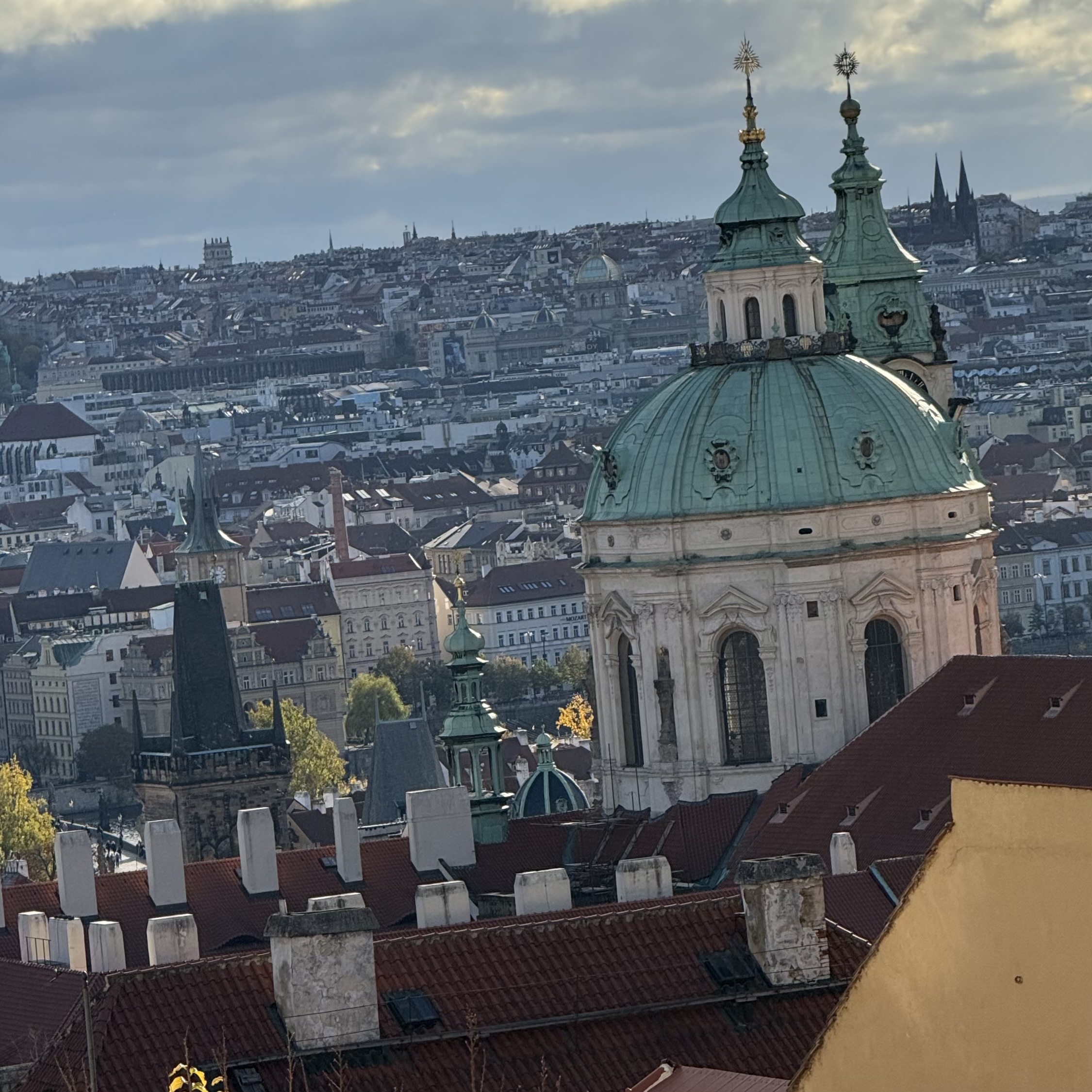
Regensburg, our final port, is a rare survivor of Allied bombings, its medieval skyline and famous bridge miraculously intact. From there, we rode through farmland to Prague, where Gothic spires pierce the skyline and cobblestones rattle beneath the unceasing car traffic and electric trolleys that circumvent the city. It’s hard to imagine that Soviet tanks rumbled along those same cobblestones in 1968.
Our cruise director, Amila Sehovic, was born in Bosnia-Herzegovina. Her parents fled during the civil war of the 1990s, when she was a small child. She grew up in Italy, far from the country her family still calls home. That war—fought less than a decade after Sarajevo hosted the 1984 Winter Olympics—was one of Europe’s darkest chapters.
Amila’s story stayed with me. It reminded me that the peace and beauty we travel to admire came at a terrible cost. The café-lined squares and bustling markets of Central Europe were built over ruins, their freedom reclaimed at great sacrifice.
The Wachau Valley is the most peaceful stretch of the river—terraced vineyards creeping up the slopes, baroque church towers rising from tiny villages, the scent of autumn wine in the air. Places like Melk Abbey were untouched by bombs, while upstream, Vienna and Linz were reduced to rubble by war. Vienna, with its palaces and opera houses, was painstakingly restored; Linz, once an industrial target, rebuilt itself into a modern city along the same riverbanks that once bore witness to devastation. In Linz, we saw the Memorial to the Victims of National Socialism. Here the names of hundreds of victims of Nazi persecution are carved into granite–Jews, political prisoners, Roma and Sinti, and others targeted by Hitler.
The story of Europe’s people is written not just in its monuments but in its endurance. Ours was a journey through history, across places that have learned, again and again, how to rebuild. As I watched the morning light linger on the vineyards, I thought about those old maps from childhood—how the gray has been replaced with color, and what a blessing it is to move freely across a continent that once lived divided.

 SQUIBS