
Their faces peer into a century-old camera, framed in the fashionable, wide-brimmed hats of the 1910s — unsmiling, as if they could see what the future held for them.
These sisters were the eldest daughters of Noah and Phyllis Brisbois of Ecorse Township, now part of Lincoln Park. The young woman with “Vernie” scrawled across her chest is my paternal grandmother. I was named for the daughter she lost in a fire on their farm near Brooklyn in 1932. Her sister May, the eldest in the family, lost a son that same September day.
But this story is about the third young woman in the photo — Stella. She not only would lose a child of her own in the years ahead, but her own life as well.
Stella was born July 26, 1896, on the family farm off Pepper Road. The property was part of a land grant her grandfather, Joseph Brisbois, received during the Lincoln administration. At some point, she met Edward George Jubainville, a Canadian-born, naturalized U.S. citizen who worked as a driver. He was a World War I veteran, serving from May 1917 to August 1919.
They were married on Sept. 14, 1921, by Father Raymond Champion at St. Francis Xavier Catholic Church in Ecorse. Stella’s sister and brother, Vida and Herbert Brisbois, stood up with the couple. At the time, both bride and groom were 25 years old.
In 1930, the couple was living on a farm on King Road in Brownstown Township with five children. By 1934, they had moved north to Imlay City to continue farming. Stella’s sister May was well-known in that community, according to a report in The Flint Journal. Perhaps that was part of the reason they headed to the Gateway to the Thumb, as Imlay City is known.
The headlines in the July 17, 1936, edition of The Times Herald of Port Huron tell the next part of the story:
“Mother, Son Die; 7 Hurt.”
“Car Crash Injures Priest, Farmer’s Family.”
Edward was driving. Stella — expecting their sixth child — was in the front seat with 2½-year-old Thomas on her lap. In the back seat were Estelle, Virginia, Phyllis, and Orville, along with the family’s hired man, 16-year-old Berrett Hallanthal.
The investigation found that Edward had made a left turn from M-53 onto M-21, directly into the path of a car driven by Father Edward Miotke, pastor of St. Joseph Catholic Church in nearby Ubly. The impact killed Thomas instantly. Edward suffered severe head and facial injuries. Little Orville was nearly scalped, and the rest of the family sustained cuts and bruises. First responders had to make several trips to get everyone to the hospital.
Father Miotke suffered chest injuries and was taken to a Detroit hospital. At first, rescuers thought Stella’s injuries were not severe, but she died within minutes of arriving at the hospital. Her death certificate cites a fractured skull and massive internal injuries.
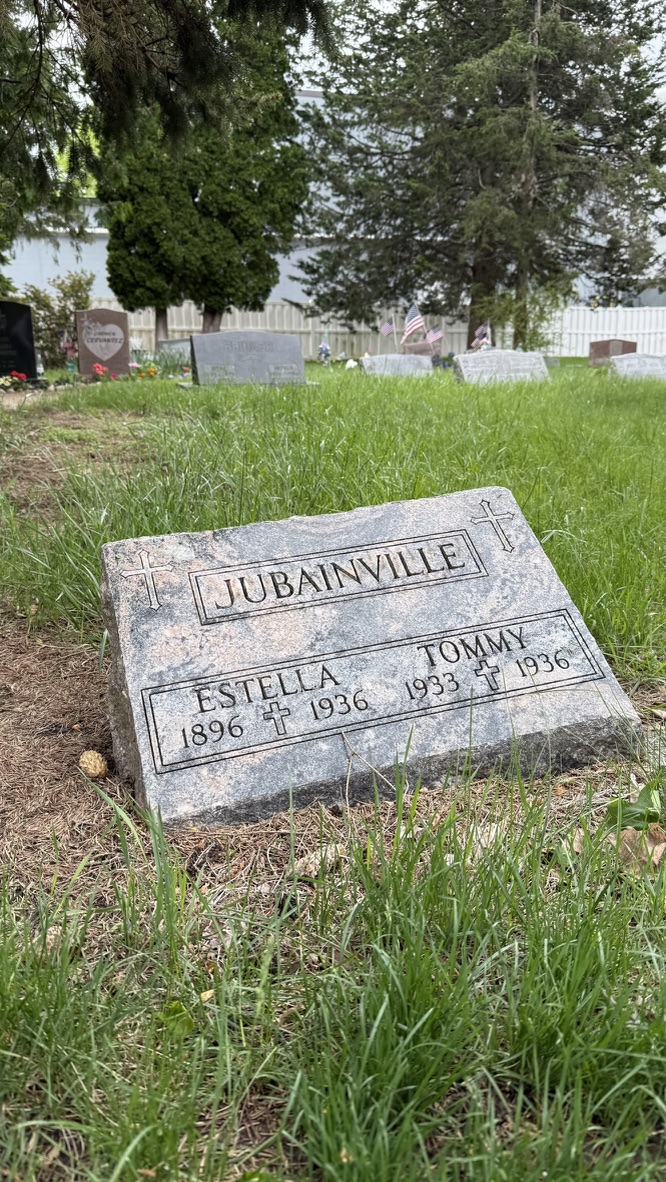
Last Saturday, my sister Lisa and I went on a day trip to find our great-aunt Stella’s grave. She is buried in Mt. Calvary Cemetery in Imlay City. The graveyard, with its proliferation of Virgin Mary and St. Francis of Assisi statuary, shares a property line with the Vlasic pickle factory — a tall plastic fence and towering spruce separating the two.
The little headstone marking their grave sits off by itself, bearing the names of Stella and Tommy and their birth and death years. Their funeral Mass took place a few days after the crash at the Catholic church in Imlay City, where the family were parishioners.
Both of my grandmothers were from large families. That meant there were a lot of funerals when I was growing up. My parents took us to nearly every funeral Mass and visitation for our great-aunts, uncles, and cousins. Some of my earliest memories are of scratchy woolen coats rubbing against my face and hands as I pushed my way through a forest of adults standing around a funeral home.
It was my parents’ way of helping us understand that life is short and that we’re all going to exit it at some point. Certainly, the tragedies that punctuated the lives of my grandmother and her two sisters are a testimony to that.

 SQUIBS