
In his play, “Romeo and Juliet,” Shakespeare wrote, “What’s in a name? That which we call a rose by any other name would smell just as sweet.” Although the Bard opines here that naming things has no real importance, I have to say that in my experience, a name can be a blessing or a curse.
I was named “Juanita Renee” when I arrived at Herrick Hospital in 1958. I was named for an aunt I would never meet and carry a name I would rarely use.
The story of my name goes back to my grandparents, Eli and Verna Lapham, who married in 1919 and moved to a farm in Norvell Township sometime in the mid-1920s.
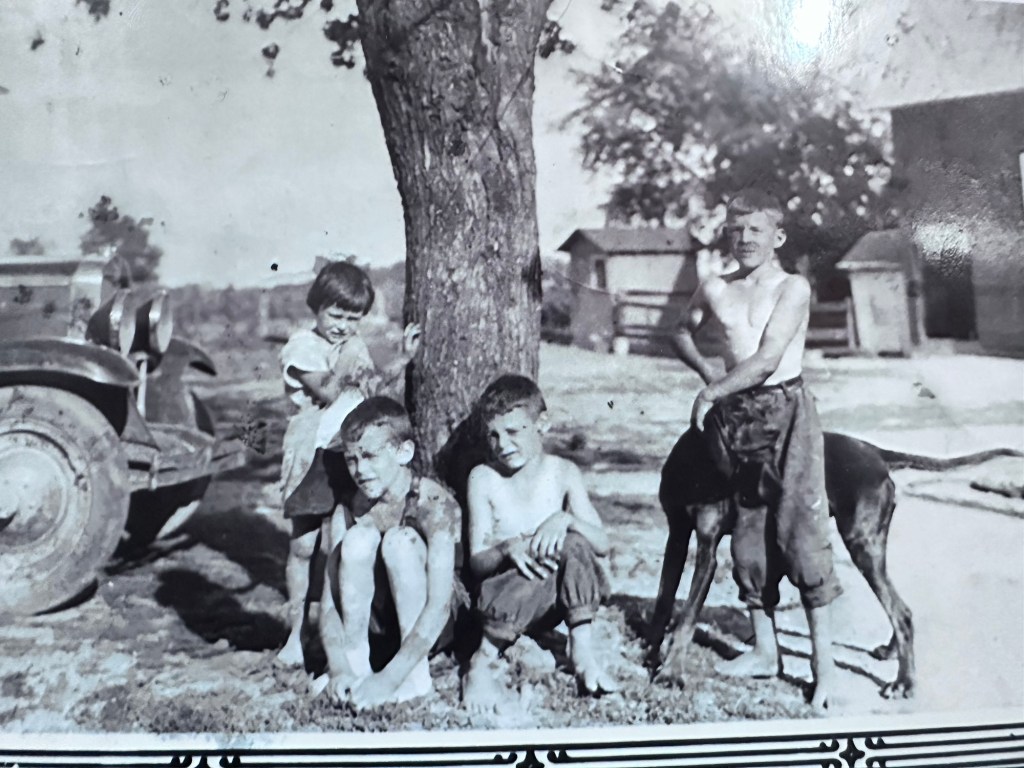
On Jan. 6, 1928, my grandmother gave birth to her first daughter, naming this fourth child, Juanita May. I do not know much about her, except that she had dark hair and dark eyes. Their farm, on Pink Street between U.S. 12 and M-124, was not far from Vineyard Lake. My grandfather worked at the Rawsonville Ford Plant and farmed about 80 acres. There were chickens and a big garden, a dairy cow or two, some pigs and other animals. By 1932, the Great Depression had hit Michigan hard, and many city folk were moving out to live with relatives on farms, where at least there was food to eat and a place to sleep. Such was the case with my grandmother’s sister, May, who moved to the farm with her husband, Henry Bondy and their children, Harold, Robert and William.
It was a hot and dry summer in Jackson County. During the threshing season, straw had been stacked up as a makeshift shelter. There was a barn with hay bales stacked inside. And on Sept. 2, 1932, there were two little children, 4-year-old Juanita, and 2-year-old William, playing in the barn. Somehow, the two children got ahold of some matches.
The Brooklyn Exponent reported it in detail. “A straw stack playhouse became a death trap for two little children on the Eli Lapham farm east of Vineyard Lake.” It did not take long for the fire to burn its way through the dry hay and burn the children to death. My grandmother discovered the fire, according to the newspaper report, and was driven back by the blaze. Those who rushed to help could do nothing but watch. My grandparents, my uncles, my father, all of them were witnesses.
Some years ago, I talked to my father’s cousin, Howard Perry, who was 5 at the time of the fire and living in Detroit. His mother was my grandmother’s sister, Vida. Howard recalled what he knew about the tragedy. He remembered walking into a store and seeing a headline in a Detroit newspaper about the fire. He recalled visits to the farm in the years after the fire and said my grandmother’s arms had been badly burned.
“Your Mimmi’s arms were scarred from that,” Howard said.
I had never noticed those scars.
The funeral for the children was held three days later, on Sept. 5, at St. Joseph Shrine. The newspaper account reports the charred remains of the two were placed in the same casket and buried in the churchyard cemetery. But their grave was never marked and the day never mentioned again.
In 2012, I wanted to rectify that. I began searching for the unmarked grave in the old cemetery. It wasn’t hard to find as the parish records go back much further than 1932. We found a headstone at an estate sale and had it engraved with “Juanita Lapham” and “William Bondy” and their dates of birth and death. We had a concrete pad poured and the stone was set in place, under a pine tree near the cemetery entrance. I visit it whenever I visit the rest of my aunts and uncles and all of my grandparents who are laid to rest there.
So what is in a name? For me, the legacy of a tiny life and tragic death that I know little about, except now it’s a life that will never be forgotten.
 SQUIBS